


Project methodology
The standards were developed through a structured, collaborative approach from early 2024 to late 2025, resulting in Australia’s first health practitioner pain management education standards.
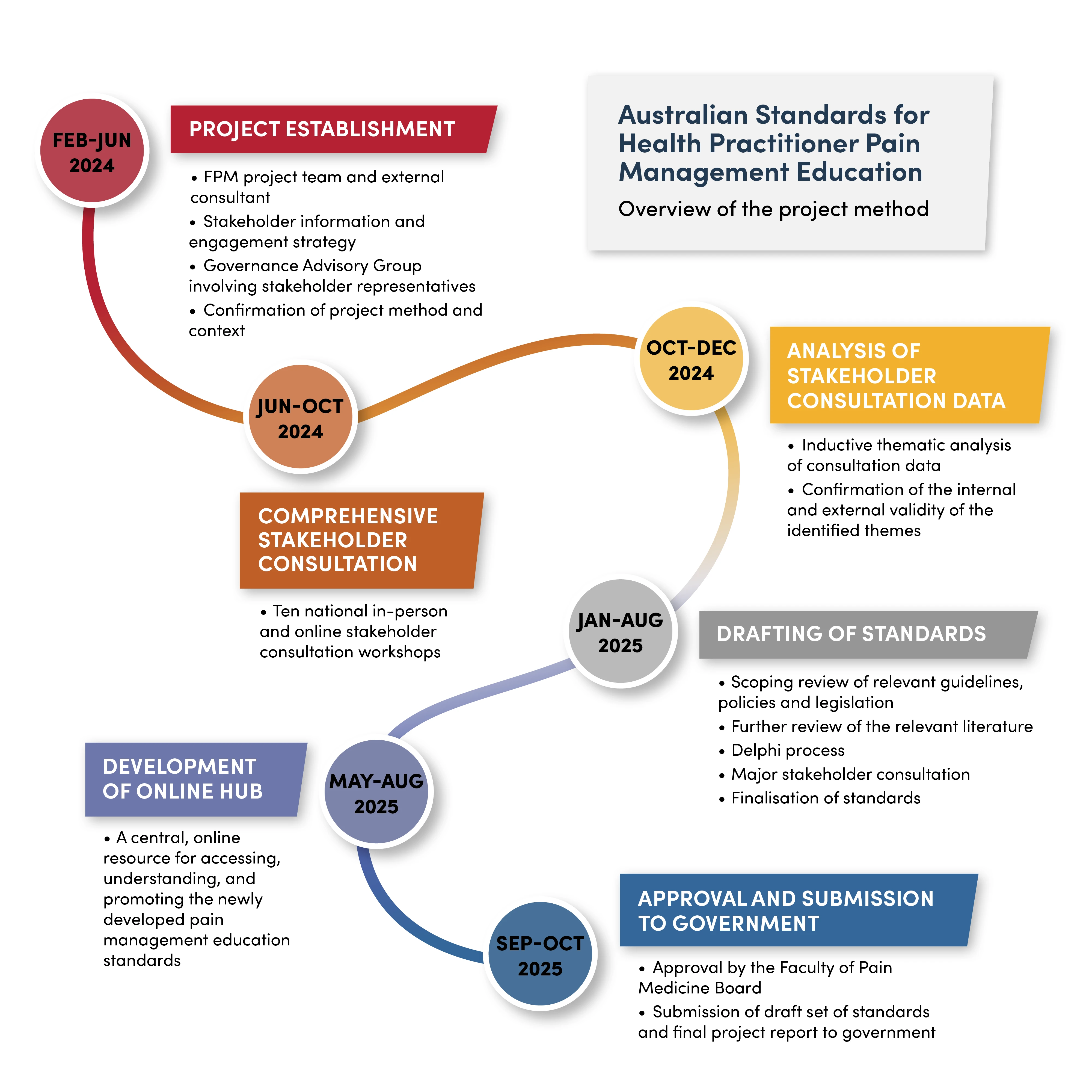
The project commenced with extensive consultation involving more than 260 stakeholders, followed by rigorous analysis, drafting and refinement informed by evidence review and consensus methods. The final Standards were approved by the FPM Board and submitted to government for endorsement before being published to support broad access and implementation. For further detail, please download the full document.
Structure
There are six overarching standards that define high-quality education and training in pain management. They articulate the core principles underpinning effective curriculum design, delivery and evaluation within the broader education and training development cycle.
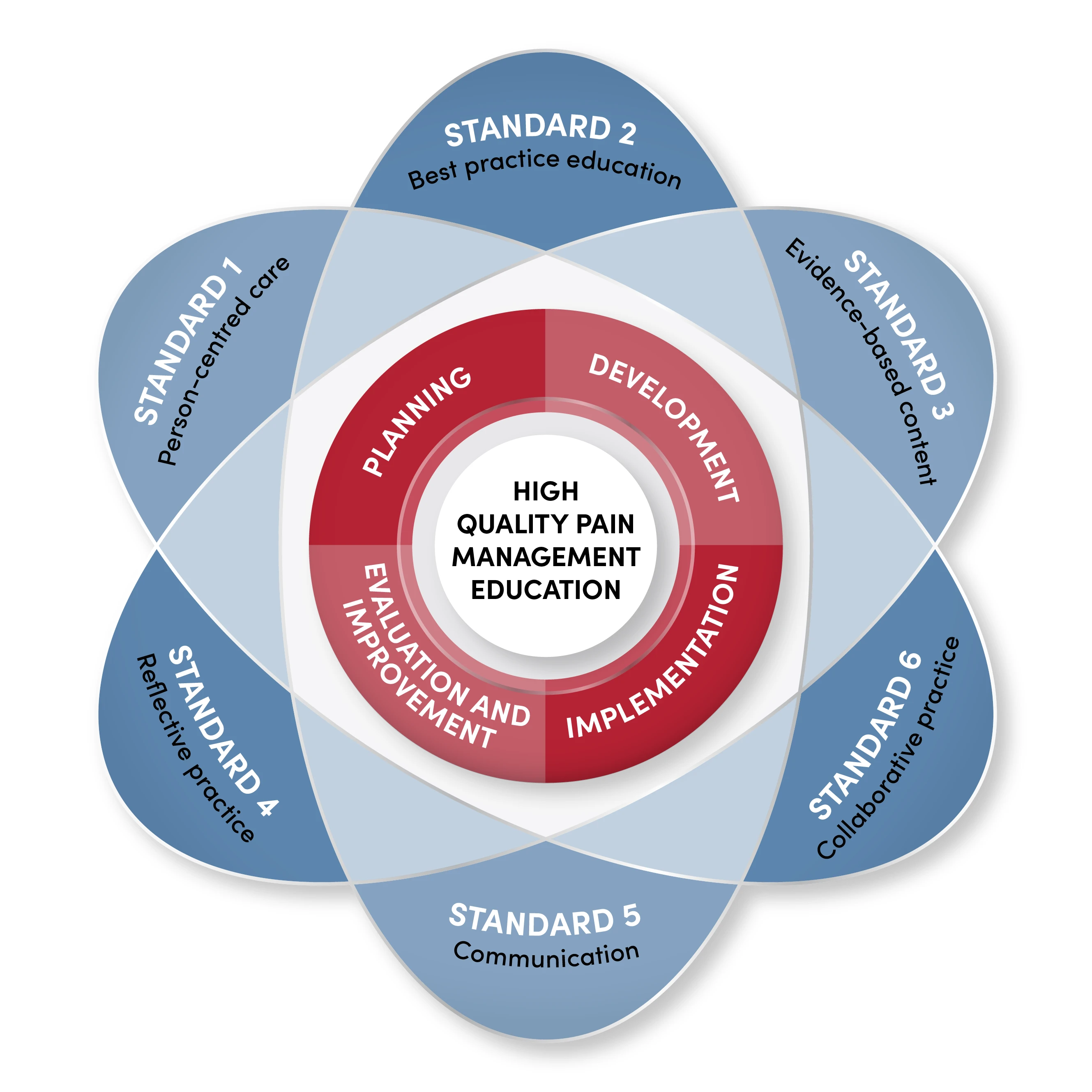
Figure 1: Relationship of the overarching standards to the education and training development cycle.
The education and training development model illustrates the core stages fundamental to designing and delivering programs for health practitioners. It reflects a cyclical process of planning, development, implementation and evaluation to ensure education and training achieves its intended outcomes and maintains consistently high quality. The stages of this model are outlined in more detail below.
Education and training development cycle
In the initial stage, planning the education and training, the educational goals, needs, and learning objectives are defined; the target audience and required resources are determined; and learning methods and assessment strategies established. The planning phase includes:
- Needs assessment: Needs assessment is identifying the needs of the stakeholders, including the needs of the relevant population of people experiencing pain, needs of the target health practitioner audience and the education and training goals are aligned with these needs.
- Goals and objectives: Broad aspirations and specific objectives for the educational program are determined using the SMART framework where specific, measurable, achievable, relevant, and time-bound learning outcomes are defined.
- Methods: The most appropriate learning methods and techniques to achieve the objectives are determined.
- Evaluation: A plan is developed for how student learning and program effectiveness will be evaluated.
In the next stage, a curriculum and/or course content addressing stakeholder needs, goals and objectives is developed, incorporating the planned methods and evaluation. The development phase includes:
- Curriculum development: Curriculum is created, including the learning outcomes, course content, instructional activities, learning materials and assessment tools, ensuring the course meets the identified learning objectives and learning standards.
- Delivery methods: Designing the learning environment, including physical spaces and online platforms.
In the next stage, the course content and learning activities are delivered, feedback is provided, and learner progress is assessed. The implementation phase includes:
- Course delivery: Course content is delivered using effective teaching methods, activities, and assessments.
- Assessment and feedback: Feedback is provided to learners on their performance using formal and/or informal feedback and assessment mechanisms.
The next phase addresses ongoing evaluation and refinement of the education and training based on stakeholder response, learner feedback and performance data to ensure the education is maintained at a high standard. This stage includes:
- Evaluation: Data on the learner outcomes and program effectiveness is collected. This may also extend to collecting data from individuals who experience pain.
- Feedback and reflection: Educators reflect on their practices and identify areas for improvement.
- Continuous improvement: Evaluations and reflection are used to refine the education and training program, including curriculum, course content, delivery methods and assessment.
The six standards intersect with the model of education and training development. Each of the core themes of these standards are relevant to, and should be considered at, multiple stages throughout the cycle of education and training development.
Each of the themes captured by the standards are further delineated within several specific standards that define the level of quality that education and training in pain management should achieve to be of the highest quality. Criteria outline how meeting the standard is demonstrated. Individual standards and their criteria will be relevant to various stages in the development cycle, depending on their specific focus.
Key documents
Explore the standards
Education and training on pain management for health practitioners promotes a person-centred approach to care.
Education and training on pain management for health practitioners is developed and delivered in alignment with best practice approaches to learning and teaching.
The content of education and training on pain management for health practitioners is evidence-based.
Education and training on pain management actively engages learners in reflective practice and self-awareness.
Education and training on pain management develops a health practitioner’s understanding of, and effective skills in, communicating with people experiencing pain.
Education and training on pain management for health practitioners embeds a collaborative approach to pain management.
Last modified: